This lesson is for those who want to maximize their health. If you’re more casual about your well-being, you can skip overthinking deuterium. However, understanding and managing deuterium is essential if you aim for optimal health.
What Is Deuterium?
Deuterium is a heavier version of hydrogen. It’s still hydrogen, but with some extra weight (1 proton + 1 neutron instead of just a proton).
It’s natural and is present in the water you drink, the food you eat, and even the air you breathe. Your body uses it constantly.
In nature, humans were exposed to significantly lower levels of deuterium. Historically, most of our water and food fell within the 120–130 ppm range. In today’s world, however, that’s rarely the case. In the rest of this module, I’ll break down the major food groups and show you how to navigate your diet and lifestyle to optimize for low deuterium intake.
The Main Harm
In simple terms, the main harm of an unbalanced amount of deuterium is mitochondrial function. Paul Saladino, one of the first mainstream doctors I have ever heard speak on this, discussed it some years back.
It seems in recent years he forgot all about his once-innovative deuterium lesson...

Anyways, the point is that we want optimal deuterium levels for ideal mitochondrial and metabolic function.
How to get ideal deuterium levels
The ideal range for deuterium in your blood plasma and body water is 120–130 ppm for optimal health and mitochondrial function. To achieve this:
Stick to foods and drinks that fall within this range.
Avoid foods and beverages that exceed 150 ppm, especially those with higher deuterium concentrations.
What compounds boost deuterium?
To understand the fundamentals, these 5 key compounds artificially raise the deuterium of a consumable item:
water
sugars (fructose, glucose, sucrose)
seed oils
starch
fiber
In short, when considering your deuterium, avoid consuming foods or beverages (unless water is specifically low in deuterium) to manage your intake.
Best Foods for Optimal Deuterium Levels
Grass-fed beef (muscle meat): 125–135 ppm
Beef liver, heart, organ meats: 120–130 ppm
Pasture-raised eggs (yolks): 128–135 ppm (Yolks are lower than whites)
Raw grass-fed butter/tallow: 125–130 ppm (Super low, optimal)
Wild-caught fatty fish: 125–135 ppm (Lower than farmed fish due to natural diet)
Raw milk (grass-fed): 135–140 ppm (Higher in fat, but still decent)
Water:
In modern day, water is actually relatively high in deuterium by default unless you intentionally seek out low-deuterium sources.
I used ChatGPT to make a breakdown of the PPM cost and the ROI of different water sources:
(I personally rated the ROI, not the AI btw)
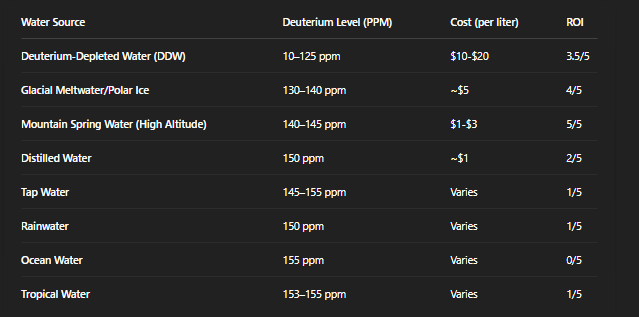
Conclusion:
-Buy Fiji water (140ppm, $1.50 per liter)
-Buy Mountain Valley spring water (140ppm, $1.50-$5 per liter)
Now let's look at some other food groups and their deuterium PPM(Remember, we want as close to 120-130 PPM as possible)
Grains: Typically 150-160 PPM
Wheat: 155 ppm
Rice: 155 ppm
Oats: 150 ppm
Corn: 145 PPM
Potato: 145 PPM
Grains will typically be very high in deuterium, and this shouldn't come as a surprise, as you have learned throughout the course that grains are just sugar, anti-nutrients, and fiber, and are technically seeds.
When we look at our deuterium checklist, we see that grains mark off essentially 4/5 of the key deuterium-raising components.
water
sugars (fructose, glucose, sucrose)
seed oils
starch
fiber
Even if you include carbs in your diet, getting them from grains is not a good idea.
Other seeds, such as nuts, have a similar range of PPM, so to be concise, I won't cover them.
Dairy: Typically 140-155 PPM
Examples:
Milk: 150 ppm (grass fed 140ppm)
Cheese: 145-150 ppm (grass-fed 135-140ppm)
Yogurt: 150 ppm (grass fed 140ppm)
It may come as a surprise, but dairy isn't too low in deuterium.
Dairy typically sits in the high-moderate range.
Prioritizing grass-fed dairy will ensure a more moderate deuterium level.
Animal Products: Typically 120-140 PPM
If you are consuming wild animals caught/raised outside, fed their natural diet, and not overly processed, their deuterium typically falls into an ideal range of closer to 125 PPM.
Factory-farmed pigs fed soy will have higher levels of deuterium, and frankly, the deuterium will be a lower-tier issue if you are consuming these animals anyway.
Again, here are the fundamental foods with ideal deuterium levels:
Grass-fed beef (muscle meat): 125–135 ppm
Beef liver, heart, organ meats: 120–130 ppm
Pasture-raised eggs (yolks): 128–135 ppm (Yolks are lower than whites)
Raw grass-fed butter/tallow: 125–130 ppm (Super low, optimal)
Wild-caught fatty fish: 125–135 ppm (Lower than farmed fish due to natural diet)
Raw milk (grass-fed): 135–140 ppm
Oils and Fats:
Fats: Typically 110-130 PPM
Oils: Typically 130-160 PPM
Tallow: 128 PPM
Lard: 116 PPM
Ghee: 125 PPM
Olive Oil: 130 PPM
Canola Oil: 160 PPM (really bad LOL)
Avocado Oil: 130 PPM
Butter: 124 ppm
Fruits: Typically ~150 PPM
Watermelon: 150 ppm
Orange: 150 ppm
Banana: 147–150 ppm
Apple: 145–150 ppm
Grapes: 149–150 ppm
Blueberries: 148–150 ppm
Vegetables: Typically 140-160 PPM
Leafy Greens (Spinach, Kale, Lettuce): 140-150 ppm
Carrots: 150 ppm
Broccoli: 145-150 ppm
Tomatoes: 145 ppm
Cucumbers: 145-150 ppm
Bell Peppers: 150 ppm
Cauliflower: 150 ppm
Zucchini: 150 ppm
Squash: 145-150 ppm
In conclusion, carefully selecting foods, drinks, and even water sources can optimize serum deuterium levels and support mitochondria and improve overall well-being.
While this may seem like a more advanced approach to health, it is one of the many crucial factors to nail for those committed to achieving optimal health.